

Computational insights into enhanced deubiquitination by SARS-CoV-2 PLpro K232Q - A structure - function study
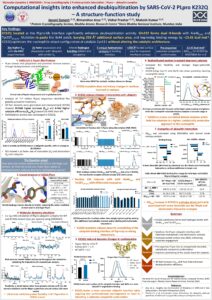
Papain-like protease (PLpro) of SARS-CoV-2, a domain of non-structural protein 3 (Nsp3), plays dual role in its pathogenesis by processing viral polyproteins and modulating host immunity through deubiquitination and deISGylation. To examine how mutations influence these functions, we performed large-scale computational analysis of ~14 million Nsp3 sequences from the GISAID database using custom Python pipelines (Arya, et al., 2023: Microbial Pathogenesis, 185, 106460). This analysis identified five mutations (A145D, P77L, P77S, V187A, and K232Q) with significant global prevalence, associated with multiple variants of concern. Among these, we found that the K232Q mutation significantly increased (~four-fold) deubiquitination activity compared to the wild-type enzyme in our biochemical assays. Sequence comparison with SARS-CoV-1 suggested that this substitution represents a reversion to its ancestral residue, consistent with the higher deubiquitination activity observed in SARS-CoV-1 PLpro. Structural mapping placed residue 232 at the ubiquitin-binding interface, prompting molecular dynamics simulations of the PLpro-ubiquitin complex (PDB: 7RBR) which revealed a shift in interaction behaviour. In the wild-type, K232 alternates between interactions with A46(Ub) and Y207(PLpro), whereas Q232 forms more balanced and persistent contacts with both residues, along with a shorter interaction distance to A46(Ub). Trajectory analysis using MDAnalysis indicated changes in substrate positioning near the catalytic site and buried surface area, while DCCM and MM-PBSA analyses further revealed differences in correlated motions and binding energetics between mutant and wild-type systems. Together, these results provide a structural basis for the enhanced catalytic activity of K232Q PLpro to uncover subtle changes in enzyme–substrate dynamics due to mutation.
Co-authors: Rimanshee Arya, Vishal Prashar, Mukesh Kumar
Contact Attendee
Warning: Attempt to read property "user_email" on string in /home/1276969.cloudwaysapps.com/ydbgzhdjeq/public_html/wp-content/plugins/my-conference-now/functions.php on line 2826