

C-T.46: Accurate Cell Density Estimation with Nucount Uncovers Novel Tissue Typologies in Spatial Transcriptomics
Authors
Oscar OTERO-LAUDOUAR
LBMC, ENS de Lyon, CNRS UMR 5239, Inserm U1293, Université Claude Bernard Lyon 1, 69007, Lyon, France
Nuria Sánchez de la Blanca Carrero
Instituto de Investigación Sanitaria del Hospital Universitario de La Princesa
Rebeca Martínez Hernández
Instituto de Investigación Sanitaria del Hospital Universitario de La Princesa
Ghislain DURIF
LBMC, ENS de Lyon, CNRS UMR 5239, Inserm U1293, Université Claude Bernard Lyon 1, 69007, Lyon, France
Philippe BERTOLINO
INSERM U1052, CNRS UMR5286, Cancer Research Center of Lyon, 69372, Lyon, France
Franck PICARD
LBMC, ENS de Lyon, CNRS UMR 5239, Inserm U1293, Université Claude Bernard Lyon 1, 69007, Lyon, France
Keywords
spatial transcriptomics, cell count, spatial local correlation, spatial niches
[sponser-meet-now-chat][/sponser-meet-now-chat]
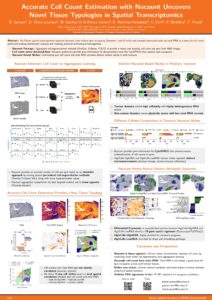
Spatial transcriptomics enables exploration of gene expression profiles linked to spatial context. Current technologies such as 10x Genomics Visium assume that each spot captures ~10 cells, which is often inaccurate in complex and heterogeneous tissues. In practice, the true cellular density per spot remains unknown, and total transcript counts are frequently used as a proxy. This approximation introduces biases in downstream analyses, including deconvolution, differential expression, while masking biologically relevant variability associated with cell density.
Here, we introduce Nucount, an AI-based framework for predicting cell numbers per spot from histological images. Nucount leverages an ensemble learning strategy, integrating multiple segmentation and detection models to generate robust consensus estimates. We benchmarked Nucount using combinations of StarDist, Cellpose, and YOLO on the PanNuke dataset, which includes thousands of annotated nuclei across diverse tissue types.
Our results demonstrate the value of accurate cell count estimation by incorporating Nucount predictions into deconvolution pipelines. By constraining methods such as CytoSPACE to respect the number of cells per spot, we achieve more precise and physically grounded cell-type assignments, supported by validation analyses. Finally, we explore the interplay between cell density and transcriptional activity in pathological tissues (cancer and auto-immunity). Using Bivariate Local Lee's spatial statistics, we identify regions of concordance and discordance between cell density and total RNA abundance. These regions exhibit distinct cellular compositions, revealing a novel morpho-transcriptomic landscape that links tissue structure to gene expression variability. Overall, Nucount provides a robust and flexible framework enabling more accurate and biologically meaningful interpretations of tissue heterogeneity.
Co-authors: Oscar Otero Laudouar, Nuria Sánchez de la Blanca Carrero, Rebeca Martínez Hernández, Ghislain Durif, Philippe Bertolino, Franck Picard
Contact Attendee
Warning: Attempt to read property "user_email" on string in /home/1276969.cloudwaysapps.com/ydbgzhdjeq/public_html/wp-content/plugins/my-conference-now/functions.php on line 2826