

C-S.B.59: Ecoli-GEM, an updated and standardized consensus genome-scale metabolic model, shows that E. coli is proton-saturated
Author
Keywords
systems biology, genome-scale metabolic modelling, standardization, energy metabolism
[sponser-meet-now-chat][/sponser-meet-now-chat]
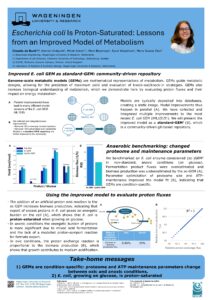
Genome-scale metabolic models (GEMs) provide valuable insight into microbial systems. The first GEM of the model organism Escherichia coli was developed in 2000. The model has been updated several times, arriving at the most recent version iML1515 (2017). Over the years, several studies published improvements to the iML1515-model, but these improvements have not been integrated, leading to several parallel versions of iML1515. We have, therefore, combined previously reported modifications of the iML1515-model to arrive to a consensus model: Ecoli-GEM.
This consensus model is distributed in a standardized way called Standard-GEM, which is a defined github repository structure. As such, we have created an efficient way to collaborate on improving the E. coli model, as parallel versions and model duplications have been merged. This increases the model quality since all current improvements have been verified, and future alterations can be openly discussed in the repository.
We have used the Ecoli-GEM (and its enzyme-constrained version) to study the biological role of protons in E. coli, as proton fluxes are linked to the energy metabolism. We show that E. coli is not only nutrient-limited, but also energy-limited due to proton-saturation as maintaining a neutral cytosolic pH places an energetic burden on the cell. We have quantified this energetic burden for different carbon sources, in oxic and anoxic conditions, and we show that the recent insights in the dynamics of formate transporter (FocA) greatly impact the simulated growth rate. These insights in the dispersion and biological relevance of GEMs will improve their applicability in metabolic engineering studies.
Co-authors: Kennet Lindquist, Mihail Anton, Mark Bisschops, Ruud Weusthuis, Maria Suarez Diez
Contact Attendee
Warning: Attempt to read property "user_email" on string in /home/1276969.cloudwaysapps.com/ydbgzhdjeq/public_html/wp-content/plugins/my-conference-now/functions.php on line 2826