

C-S.B.46: Integrating LINCS L1000 transcriptomic repurposing with graph convolutional drug-target interaction prediction identifies subtype-specific therapeutic candidates and novel targets in IBD
Authors
AI-Bio Convergence Research Institute, Soongsil University, Seoul, Republic of Korea
Seo Young Jung
Department of Bioinformatics, Soongsil University, Seoul
Jae Yong Ryu
School of Systems Biomedical Science, Soongsil University, Seoul
Keywords
Inflammatory bowel disease, ulcerative colitis, drug repurposing, LINCSL1000, SSGCN, cholesterol uptake inhibitor, HDAC inhibitor
[sponser-meet-now-chat][/sponser-meet-now-chat]
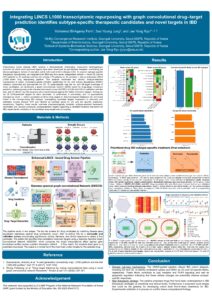
Inflammatory bowel disease (IBD) remains a therapeutically challenging, molecularly heterogeneous condition for which most approved agents have been developed as pan-disease therapies, overlooking the distinct pathogenic drivers of ulcerative colitis (UC) and Crohn's disease (CD). To uncover subtype-specific therapeutic opportunities, we integrated bulk RNA-seq from seven independent cohorts — three CD cohorts (317 patients vs. 91 controls) and four UC cohorts (175 patients vs. 94 controls) — into an enhanced LINCS L1000–based drug repurposing pipeline. This analysis nominated two distinct, subtype-selective mechanisms of action: cholesterol-uptake inhibition (ezetimibe) for UC and histone deacetylase (HDAC) inhibition (vorinostat and pyroxamide) for CD. To systematically map the on- and off-target landscape of these candidates, we developed a graph convolutional network (GCN) model for drug–target interaction prediction, achieving area-under-the-precision-recall curves (AUPRC) of 0.89 and 0.95 on validation and test sets, and 74–80.5% top-100 accuracy when benchmarked against the Pabon reference dataset. Among the top 30 GCN-predicted targets for each candidate, 13 (ezetimibe), 6 (vorinostat), and 14 (pyroxamide) emerged as novel — neither annotated as direct drug targets in pharmacological databases nor previously linked to the corresponding IBD subtype. Investigating candidate targets’ expression in discovery and validation cohorts showed VCP and HDAC4 as cadidate tarets for UC and CD specific treatments, respectively. Together, these results nominate pharmacologically tractable, subtype-resolved therapeutic candidates and uncover previously uncharacterized targets supporting a stratified-medicine framework for IBD; experimental validation of the prioritized drug–target pairs is ongoing.
Contact Attendee
Warning: Attempt to read property "user_email" on string in /home/1276969.cloudwaysapps.com/ydbgzhdjeq/public_html/wp-content/plugins/my-conference-now/functions.php on line 2826