

C-S.B.24: Topology-aware reconstruction of cellular state landscapes from microscopy using self-supervised learning
Keywords
Computer vision, microscopy, SimCLR, ALS, transition graph, optimal transport, astrocyte, self-supervised learning
[sponser-meet-now-chat][/sponser-meet-now-chat]
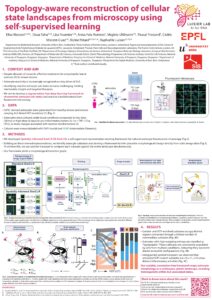
Astrocyte reactivity is a central contributor to neurodegeneration, yet the morphological heterogeneity of reactive states and their relationship to transcriptional programs remain poorly understood. A key challenge is that biological conditions rarely correspond to a single, homogeneous phenotype, a complexity obscured in aggregate population analysis.
Here, we address this by generating a multimodal dataset of human iPSC-derived astrocytes from ALS patients and controls, profiled by high-content fluorescence imaging and bulk RNA sequencing under basal and controlled pro-inflammatory conditions. We develop SI-SimCLR, a spatially informed contrastive learning framework that learns biologically meaningful representations from microscopy images, without segmentation or predefined labels. SI-SimCLR outperforms standard baselines in capturing disease- and inflammation-associated morphological variation across experimental batches.
Unsupervised analysis of SI-SimCLR embeddings revealed a structured morphological landscape composed of twelve distinct substates. Using Optimal Transport to construct a morphological transition graph, we found VCP-mutant astrocytes occupy a constrained genotype-specific region under basal conditions, while high-dose inflammatory stimulation partially shifts these states toward control-like configurations. Substate-resolved analysis further highlighted untreated VCP-mutant astrocytes as cell-autonomous morphological states overlapping with inflammation-induced reactive phenotypes.
Integration with bulk RNA sequencing revealed a striking dissociation: while inflammatory stimulation dominates transcriptional variation, the ALS mutation primarily drives morphological organization. This indicates morphological and transcriptional responses to disease represent partially independent axes of astrocyte dysfunction.
Together, these results establish a scalable, annotation-free framework for high-resolution characterization of phenotypic heterogeneity, providing a principled foundation for substate-resolved analysis of astrocyte biology in neurodegeneration and beyond.
Co-authors: Doaa Taha, Lisa Fournier, Anna Foix Romero, Virginie Uhlman, Pascal Frossard, Cédric Vincent-Cuaz, Rickie Patani, Raphaëlle Luisier
Contact Attendee
Warning: Attempt to read property "user_email" on string in /home/1276969.cloudwaysapps.com/ydbgzhdjeq/public_html/wp-content/plugins/my-conference-now/functions.php on line 2826