

C-S.B.15: Systematic capture of human receptor-ligand interactions as Gene Ontology Causal Activity Models
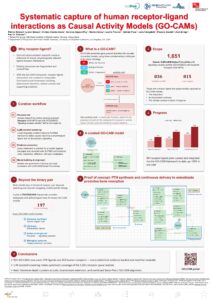
Cell-cell communication is crucial for the development of complex multicellular organisms. In systems biology, computational biology, and biomedical research, elucidating cell-cell interactions requires a comprehensive reference database of robust, physiologically relevant ligand-receptor interactions. However, existing biological resources suffer from fragmented coverage, lack pathway and cellular context, and show poor cross-resource consistency. To address this, we have begun a targeted biocuration effort using the Gene Ontology Causal Activity Model (GO-CAM) framework. GO-CAMs integrate gene product activities into causally connected, machine-readable models by using three complementary ontologies: Molecular Function (MF), Biological Process (BP), and Cellular Component (CC) from the Gene Ontology (GO). Applied to receptor-ligand biology, GO-CAM connects interactions to downstream signalling pathways, specifies the cell types in which they occur, and captures microenvironmental context such as subcellular localisation and co-interacting proteins. Of the more than 1,600 human receptors catalogued in UniProtKB/Swiss-Prot, those with known ligand interactions will be systematically represented as GO-CAM models, using LLM-assisted literature screening to identify and extract the relevant experimental evidence. To date, approximately 400 receptor-ligand pairs have been curated and integrated into the GO-CAM framework.
Co-authors: Lionel Breuza, Cristina Casals-Casas, Guilaine Argoud-Puy, Nadine Gruaz, Lucille Pourcel, Sylvain Poux, Livia Famiglietti, Pascale Gaudet, Alan Bridge, Paul D. Thomas, The Uniprot Consortium
Contact Attendee
Warning: Attempt to read property "user_email" on string in /home/1276969.cloudwaysapps.com/ydbgzhdjeq/public_html/wp-content/plugins/my-conference-now/functions.php on line 2826