

C-P.47: Computational search for Myelin-associated Glycoprotein (MAG) binders that could modulate the neuroprotective properties of oligodendrocytes in neurodegenerative contexts
Authors
Department of Theoretical and Computational Chemistry, School of Chemical Sciences (FCQ), National University of Córdoba (UNC)
Rodrigo Quiroga
Department of Theoretical and Computational Chemistry, School of Chemical Sciences (FCQ), National University of Córdoba (UNC)
Keywords
Molecular docking; Virtual Screening; Myelin-Associated Glycoprotein (MAG/Siglec4)
[sponser-meet-now-chat][/sponser-meet-now-chat]
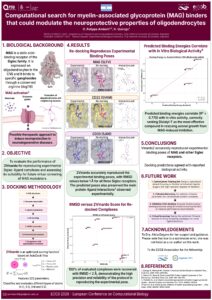
Myelin-Associated Glycoprotein (MAG/Siglec-4) is a cell-surface lectin belonging to the Siglec family, which binds sialic acid–containing glycans. MAG is expressed in myelinating oligodendrocytes of the central nervous system and is localized in the periaxonal space. It shows high specificity for the Neu5Acα2-3Galβ1-3GalNAc motif present in gangliosides such as GT1a and GD1b. Structurally, this interaction is mediated by a conserved Arg118 residue in the V domain, which forms a salt bridge with the sialic acid carboxyl group. Upon activation, MAG promotes glutamate reuptake after injury, contributing to neuroprotective and antioxidant effects in oligodendrocytes and neurons. This function is particularly relevant in neurodegenerative conditions such as stroke and multiple sclerosis.
The aim of this study is to identify potential MAG activators or inhibitors with high affinity and selectivity through molecular docking and virtual screening of diverse compound libraries (e.g., ZINC20). For this purpose, the 2VINARDO scoring function, an enhanced version of AutoDock Vina, is employed. Developed by Quiroga and Villareal, 2VINARDO improves the description of non-covalent interactions by expanding atom types and interaction parameters.
Validation of the scoring function was performed using a re-docking protocol with seven crystallographic Siglec–ligand complexes, including MAG. In all cases, ligand poses were accurately predicted (RMSD < 2 Å), preserving key interactions such as hydrogen bonds involving Arg118. Additional analyses include binding site flexibility and correlation with experimental binding affinities (Kd).
These results support the application of 2VINARDO for large-scale virtual screening, aiming to identify selective MAG modulators with potential therapeutic relevance.
Co-authors: Rodrigo Quiroga
Contact Attendee
Warning: Attempt to read property "user_email" on string in /home/1276969.cloudwaysapps.com/ydbgzhdjeq/public_html/wp-content/plugins/my-conference-now/functions.php on line 2826