

C-P.46: Residue-Level Attributions in Protein Language Models Do Not Recover Allergen Epitopes
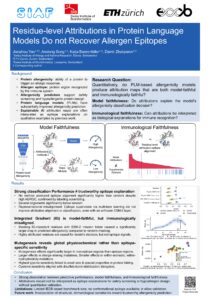
Background. Protein language models (PLMs) achieve state-of-the-art allergenicity classification, yet the molecular basis of these predictions remains uncharacterized. Residue-level attribution methods, including Integrated Gradients (IG), are widely interpreted as localizing immunologically relevant regions, but this claim has only been supported by comparisons to known epitopes and has not been quantitatively assessed against curated immunological ground truth.
Methods. We developed a residue-level benchmark for assessing immunological faithfulness in PLM-based allergenicity prediction models, defined as concordance between residue-level attribution scores and experimentally validated MHC Class II epitopes from the Immune Epitope Database (IEDB). We evaluated attribution scores across ESM-2-based classifiers, including a multi-task architecture with an auxiliary residue-level head trained under direct epitope supervision. To differentiate immunological faithfulness from model faithfulness, we conducted IG-guided masking and in silico saturation mutagenesis at high-attribution positions.
Results. Residue-level attribution scores exhibited near-random concordance with IEDB-annotated epitopes, despite high protein-level performance. Multi-task-learning recovered epitope signal in the auxiliary residue head but did not increase epitope concordance of classifier attributions, indicating epitope-relevant features are not recruited by the classification objective even when available during optimization. Masking high-attribution residues reduced prediction confidence, confirming attribution faithfulness to model decisions. Saturation mutagenesis revealed sensitivity to physicochemical properties and local compositional context rather than epitope-defining substitutions.
Conclusion. Model and immunological faithfulness are distinct: attributions can reflect decision drivers while failing to recover immunologically meaningful sequence properties. Residue-importance maps cannot be treated as biological explanations without epitope-based validation. We propose quantitative faithfulness benchmarking as necessary for interpretability evaluation in allergenicity prediction.
Co-authors: Anxiong Song, Katja Baerenfaller, Damir Zhakparov
Contact Attendee
Warning: Attempt to read property "user_email" on string in /home/1276969.cloudwaysapps.com/ydbgzhdjeq/public_html/wp-content/plugins/my-conference-now/functions.php on line 2826