

C-P.45: Mapping Evolutionary Switches Driving Functional Diversification in AsnC-like Transcription Factors
Authors
Pedro Beltrao
Institute of Molecular Systems Biology, ETH Zürich
Julian Trouillon
Institute of Molecular Systems Biology, ETH Zürich
Keywords
ancestral sequence reconstruction, specificity-determining residues, transcription factor evolution, protein-DNA recognition, effector binding, Lrp/AsnC family
[sponser-meet-now-chat][/sponser-meet-now-chat]
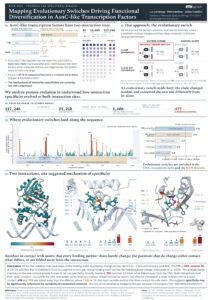
Deciphering the transcriptional regulatory code requires understanding how a transcription
factor's amino acid sequence dictates its DNA-binding specificity. AsnC-like transcription
factors (InterPro: IPR019888) form an ancient regulatory superfamily that offers a dense
evolutionary sampling for this purpose. Here, we leverage the phylogeny of the AsnC-like
family to systematically map this functional diversification.
To identify the key changes causing functional diversification, we used the burst after
duplication divergence metric with ancestral sequence reconstructions. This approach
highlights "evolutionary switches"
- residues conserved within subfamilies but different
between them, suggesting strong functional importance. By mapping the high-scoring
residues onto structural models, we can deduce their specific biological roles: switches at
the protein-DNA interface suggest residues that determine specificity, while those at
effector-binding or dimerization sites show the evolution of metabolic sensing and complex
assembly.
Beyond this, we are broadening our analysis to explore the larger factors and timing of these
functional shifts. By characterizing the physicochemical nature of the mutations at switch
sites, we aim to gain understanding of how specific substitutions alter function. By linking the
identified evolutionary switches with known DNA-binding specificities, effector molecules,
and the host species' environments, we can deduce the selective pressures that drive
regulatory adaptation. Mapping these switches across the phylogeny also allows us to
estimate when these adaptations emerged. This evolutionary approach ultimately aims at
clarifying how regulatory domains take on novel functions in the AsnC-like transcription
factor family, offering a sound basis for understanding adaptation through protein evolution.
Co-authors: Pedro Beltrao, Julian Trouillon
Contact Attendee
Warning: Attempt to read property "user_email" on string in /home/1276969.cloudwaysapps.com/ydbgzhdjeq/public_html/wp-content/plugins/my-conference-now/functions.php on line 2826