

C-G.27: Benchmarking Pathogenicity Estimation Methods with Real-World Clinical Data in Inherited Heart Disease
Keywords
ClinicalGenomics, Bioinformatics, AI, VariantInterpretation, HeartDisease
[sponser-meet-now-chat][/sponser-meet-now-chat]
Reliable classification of genetic variants, especially variants of uncertain significance (VUS), remains a major bottleneck in clinical genomics. Pathogenicity estimation is a key step in variant classification; however, most prediction tools are limited to specific variant types and lack full coverage.
FAI is a LightGBM-based predictor trained on ClinVar data (Oct 2023). It integrates variant-level features and neighbouring variant information for binary classification.
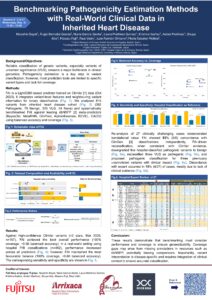
We analysed 815 variants from inherited heart disease cohort (392 Pathogenic, 70 Benign, 329 VUS, 24 None) and systematically benchmarked FAI against leading dbNSFP meta-predictors (BayesDel, MetaRNN, ClinPred, AlphaMissense, REVEL, CADD) using balanced accuracy and coverage. Against high-confidence ClinVar variants (>2 stars, Mar 2026, n=157), FAI achieved the best overall performance (~100% coverage, ~0.98 balanced accuracy). In a real-world setting using hospital classifications (n=462), performance decreased across all methods; however, FAI maintained the most favourable balance (~100% coverage, ~0.80 balanced accuracy).
Re-analysis of clinically challenging cases demonstrated translational value. FAI showed 83% concordance with ClinGen classifications. Independently, FAI-driven reclassification, when consistent with ClinVar evidence, downgraded five hospital-classified pathogenic variants to benign, reclassified three VUS as pathogenic, and proposed pathogenic classification for three previously unannotated variants with clinical impact, as confirmed by expert reconsideration. Discrepancies remained in 15% of cases, mostly due to clinical evidence.
These results demonstrate that benchmarking must consider performance and coverage to ensure generalizability. Coverage gaps may arise from missing annotations in resources such as dbNSFP, potentially biasing comparisons. Importantly, variant interpretation is disease-specific and requires integration of clinical context to ensure accurate classification.
Co-authors: Angel Bernabe Garcia, Nuria Garcia-Santa, Laura Martinez Gomez, Kristina Ibaanez, Abe Shuya, Fuji Masaru, Raul Valin, Juan Ramon Gimeno, Maria Sabater Molina
Contact Attendee
Warning: Attempt to read property "user_email" on string in /home/1276969.cloudwaysapps.com/ydbgzhdjeq/public_html/wp-content/plugins/my-conference-now/functions.php on line 2826