

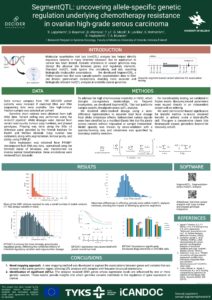
B-T.43: SegmentQTL: uncovering allele-specific genetic regulation underlying chemotherapy resistance in ovarian high-grade serous carcinoma
[sponser-meet-now-chat][/sponser-meet-now-chat]
Copy number-driven cancers are characterised by extensive chromosomal instability, creating challenges for molecular quantitative trait loci (molQTL) analysis. Sample-specific breakpoints can separate a gene from nearby regulatory variants, while allele-specific copy number changes alter the contribution of the reference and alternative alleles. Modelling variant effects in these tumours therefore requires accounting for structural context and allelic imbalance.
To address this, we developed SegmentQTL, which integrates sample-specific segmentation with allele-resolved dosage information. For each gene-variant pair, only samples in which the variant and gene remain on the same segment are considered. SegmentQTL models total local dosage and allelic imbalance, distinguishing effects driven by overall copy number from those arising through preferential retention or amplification of one allele.
SegmentQTL includes a finemapping mode using a modified Elastic Net and stability selection to accommodate segment-filter-induced missingness. Because different variants remain linked to the gene in different samples, standard multi-variable models would require either imputation or restricting analysis to samples shared across variants. SegmentQTL instead jointly analyses cis variants without imputation or sample loss, prioritising reproducible signals across bootstraps.
Applied to high-grade serous carcinoma, SegmentQTL highlighted several survival-associated genes. Among these, high EIF2AK1 expression was associated with poorer overall survival (adj. p = 0.01). SegmentQTL identified three independent variants regulating EIF2AK1, increasing adjusted R² by 0.07 beyond gene dosage alone (adj. R² = 0.54). Experimental knockdown increased sensitivity to paclitaxel and carboplatin, linking genetically driven EIF2AK1 upregulation to chemotherapy resistance. SegmentQTL thus offers a path from association to mechanism.
Co-authors: Déborah Boyenval, Juuli Raivola, Daria Afenteva, Yilin Li, Giulia Micoli, Kari Lavikka, Susanna Holmström, Jaana Oikkonen, Daniela Ungureanu, Sampsa Hautaniemi, Taru Muranen
Contact Attendee
Warning: Attempt to read property "user_email" on string in /home/1276969.cloudwaysapps.com/ydbgzhdjeq/public_html/wp-content/plugins/my-conference-now/functions.php on line 2826