

B-T.33: Decoding Regulatory Mechanisms of RNA-Binding Proteins within Coding Sequences
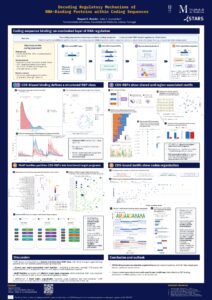
RNA-binding proteins (RBPs) are central regulators of post-transcriptional gene expression. While transcriptome-wide RBP binding studies have focused on untranslated regions and introns, recent CLIP-seq data indicate that coding sequence (CDS) binding is widespread and, for a subset of proteins, exceeds UTR binding, pointing to an underexplored layer of regulation. To characterize this protein class, we developed a computational workflow to identify CDS-binding RBPs from public human CLIP-seq data and reveal their shared and distinct regulatory features.
By defining CDS-binding RBPs as those with more than 40% of binding sites in coding regions, we find that their transcript-wide profiles show recurrent enrichment near the CDS start, consistent with roles in translation initiation and early elongation. Additionally, comparative motif discovery across CDS and non-CDS binding sites reveals distinctive motifs, while clustering across all motifs identifies motif families associated with distinct target-gene functions - including translation, transport, and RNA metabolism. For many RBPs, motifs identified in their binding sites map to distinct functional clusters, evidence of multiple regulatory modes per protein. Across CDS-binding RBPs, a purine-rich motif family is shared, suggesting a common sequence feature of CDS binding. Finally, by placing motif-associated sites in coding coordinates and examining their codon context, we identify cases in which binding recurs at the same codon, suggesting that some CDS-binding events may interface with codon-dependent regulation.
Together, these results establish CDS-binding RBPs as a heterogeneous class of post-transcriptional regulators and reveal sequence, positional, and codon-linked features that may shape their regulatory activity within coding regions.
Co-authors: João C. Guimarães
Contact Attendee
Warning: Attempt to read property "user_email" on string in /home/1276969.cloudwaysapps.com/ydbgzhdjeq/public_html/wp-content/plugins/my-conference-now/functions.php on line 2826