

B-T.31: What you express and how you split it: transcript isoform usage carries drug-response signal in cancer cell lines that current expression-based models do not capture
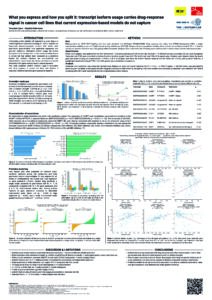
Cancer is a complex disease with diverse causes and clinical manifestations, making the identification of effective treatments a persistent challenge. Comprehensive genomic profiling assays are currently the gold standard for guiding targeted therapies; however, many patients fail to respond to recommended drugs despite detailed characterization of their mutational profiles. This limitation highlights the need for more informative predictive approaches.
Experimental and computational drug screening methods can support Molecular Tumor Boards in prioritizing treatment strategies, yet most existing predictors rely primarily on omics and gene expression data and show limited performance. Notably, alternative splicing-recognized as a key hallmark of cancer and a driver of drug resistance-remains largely underexplored in this context.
In this ongoing project, we aim to address this gap by developing a drug response and resistance prediction framework that integrates alternative splicing analysis with interpretable machine learning. Our work leverages large-scale public resources, including Cancer Cell Line Encyclopedia and The Cancer Genome Atlas, to systematically incorporate splicing-derived features alongside conventional molecular data. Current efforts focus on data integration, preprocessing pipelines, and baseline model development, while subsequent steps will evaluate the added predictive value of alternative splicing.
By incorporating this overlooked layer of regulation into predictive models, this study aims to improve the prioritization of therapeutic options and provide more informative, interpretable tools to support clinical decision-making.
Co-authors: Abdullah Kahraman
Contact Attendee
Warning: Attempt to read property "user_email" on string in /home/1276969.cloudwaysapps.com/ydbgzhdjeq/public_html/wp-content/plugins/my-conference-now/functions.php on line 2826