

B-T.18: Benchmarking Tools for the Event-Level Detection of Alternative Splicing from Short-Read Data
Authors
Wilfried Ellmeier
Medical University of Vienna
Alexandra B. Graf
University of Applied Sciences Campus Vienna
Keywords
alternative splicing, benchmarking, RNA-seq, event-level detection
[sponser-meet-now-chat][/sponser-meet-now-chat]
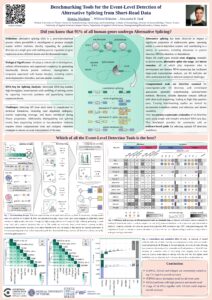
Alternative splicing (AS) is a key post-transcriptional mechanism that contributes to the diversification of transcripts and proteins by generating multiple mRNA isoforms from a single gene. AS has been observed to impact a significant proportion of multi-exonic genes, operating within a context-dependent manner and contributing to a variety of outcomes, including alterations in protein function, RNA localization, or degradation. Major AS event types include exon skipping, mutually exclusive exons, alternative splice site usage, and intron retention, all of which play important roles in development and disease. RNA sequencing has facilitated large-scale transcriptome analysis, yet AS isoforms are often underexplored due to inherent analytical challenges. Computational tools are therefore essential for transcriptome-wide AS detection, with event-based approaches generally outperforming isoform-based methods. However, reliable detection remains difficult with short-read sequencing, leading to high false-positive rates. Existing benchmarking studies are limited by inconsistent evaluation criteria, tool selection, and dataset variability.
Here, we present a systematic evaluation of AS detection tools using both simulated and real RNA-seq data. From 66 identified tools, 14 were selected through a rigorous multi-step filtering process. Performance was assessed primarily using precision and recall, prioritizing precision to minimize false positives. Additional metrics included inter-tool agreement and the impact of filtering strategies. Results were integrated into a comprehensive framework that also considers usability factors such as installation and documentation quality. This benchmark provides the community with an evidence-based guide for selecting optimal AS detection workflows and highlights opportunities to improve the accuracy and robustness of AS analysis in RNA-seq studies.
Co-authors: Wilfried Ellmeier, Alexandra B. Graf
Contact Attendee
Warning: Attempt to read property "user_email" on string in /home/1276969.cloudwaysapps.com/ydbgzhdjeq/public_html/wp-content/plugins/my-conference-now/functions.php on line 2826