

B-T.12: Understanding and exploiting CDK12-inactivation induced oncogenic androgen receptor signalling
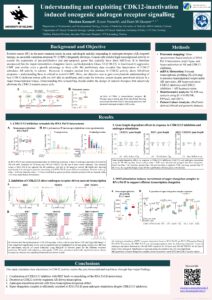
Prostate cancer (PC) is the most common cancer in men, and despite initially responding to androgen receptor (AR) targeted therapy, an incurable castration-resistant PC (CRPC) frequently develops. Cancer cells exhibit high transcriptional activity to sustain the expression of pro-proliferative and anti-apoptotic genes that typically have short half-lives. It is therefore unexpected that the major transcription elongation factor, cyclin-dependent kinase 12 (CDK12), is inactivated in aggressive CRPC and confers even a growth advantage to these cells.
We have employed multi-omics strategy to study how the decrease in CDK12 activity affects AR function by assessing nascent transcription, alternative splicing, intronic poly-adenylation, and overall transcriptional program. Our results show that inhibiting CDK12 along with AR stimulation remodels the RNA polymerase II interactome by recruiting specific factors to the polymerase to rescue PC cells from the transcription elongation defect caused by decrease in CDK12 activity. In addition, functional loss of CDK12 activity together with AR hyper-activation leads to upregulation of specific pathways that support cancer cell survival.
In brief, our data show that pharmacological inhibition of CDK12 activity alters the AR-driven cellular program and remodels the core transcription machinery in an adaptive manner. Understanding this remodelling should enable the design of rational therapies that selectively eliminate the CDK12-mutant cancer cells.
Co-authors: Eszter Zoé Németh, Harri M Itkonen
Contact Attendee
Warning: Attempt to read property "user_email" on string in /home/1276969.cloudwaysapps.com/ydbgzhdjeq/public_html/wp-content/plugins/my-conference-now/functions.php on line 2826