

B-S.B.77: Predicting Rheumatoid Arthritis Flare Risk to Guide Treatment Tapering Recommendations Across Multiple Data Modalities Using Explainable AI
Authors
Keywords
Rheumatoid arthritis; flare prediction; treatment tapering; explainable AI; machine learning; multimodal data; SHAP; precision medicine; biomarker discovery
[sponser-meet-now-chat][/sponser-meet-now-chat]
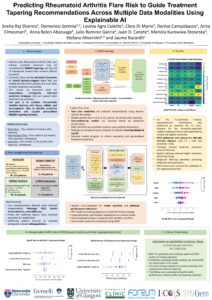
AI is transforming biomedical research by enabling analysis of complex, high-dimensional datasets for precision medicine applications. However, leveraging diverse omics data sources for predictive modelling remains challenging due to heterogeneity, and small cohort sizes. In this work, we designed AI analysis pipelines to predict Rheumatoid Arthritis (RA) flare risk upon therapy tapering/discontinuation and support treatment decisions.
Data were collected from 100 RA patients in sustained clinical and imaging remission at Fondazione Policlinico Universitario A. Gemelli IRCCS. Synovial tissue samples were profiled using multiple modalities, including histology (n=100), flow cytometry (n=53), spatial transcriptomics (n=21), and single-cell RNA sequencing (n=23). Flare occurrence within 6 months was used as prediction endpoint.
A unified pipeline was used across all datasets, incorporating feature selection (recursive feature elimination), hyperparameter optimisation (Bayesian search) and Logistic Regression, Random Forest and XGBoost as classifiers, with nested cross-validation used for pipeline training and model selection. In modalities generating multiple instances per patient these were treated as independent observations but ensuring that all rows of a patient were either in training or test sets by performing cross-validation at patient level.
Across datasets, we evaluated multiple models and sampling strategies, observing trade-offs between metrics. Performance variations highlighted influence of both data sources and algorithmic choices Explainable AI (SHAP) was used to identify biomarkers' role in models and further support decision making. In conclusion, among all models tested, cross validation AUC ranges between 0.66 to 1 across different datasets. This approach is currently being evaluated in an ongoing clinical trial (ClinicalTrials.gov ID: NCT05952440).
Co-authors: Domenico Somma, Lavinia Agra Coletto, Clara Di Mario, Denise Campobasso, Aziza Elmesmari, Lucy MacDonald, Julio Ramirez, Maria Rita Gigante, Juan Canete, Mariola Kurowska-Stolarska, Stefano Alivernini, Jaume Bacardit
Contact Attendee
Warning: Attempt to read property "user_email" on string in /home/1276969.cloudwaysapps.com/ydbgzhdjeq/public_html/wp-content/plugins/my-conference-now/functions.php on line 2826