

B-S.B.48: GluSynDB: Stratifying Glutamatergic Synapse Variants
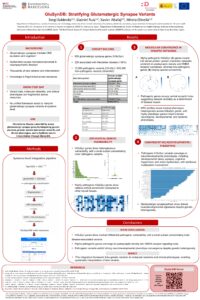
Glutamatergic synapses mediate the major excitatory signaling in the central nervous system and are critically implicated in neurodevelopmental and neurological disorders. However, how genetic variation across glutamatergic synapse genes translates into disease vulnerability and phenotypic diversity remains poorly understood.
Here, we present a systems-level analysis of 626 human glutamatergic synapse genes integrating genetic variation from gnomAD and ClinVar with tissue expression, protein–protein interaction networks, Gene Ontology annotations, and Human Phenotype Ontology data. To quantify gene-level disease association, we introduce a pathogenesis ratio that captures the relative enrichment of pathogenic variants while accounting for mutational burden.
We show that disease-associated variation is highly non-uniform and concentrated in a small subset of genes, with approximately 10 genes accounting for ~55% of pathogenic variants. These highly vulnerable genes are preferentially expressed in cortical regions and occupy central positions within synaptic interaction networks, forming hubs enriched in postsynaptic density and NMDA receptor signaling. In contrast, low-pathogenicity genes display sparse connectivity and reduced network integration.
At the clinical level, glutamatergic synapse genes exhibit strong phenotypic convergence, predominantly affecting neurodevelopmental functions despite substantial genetic heterogeneity.
Together, our results reveal a hierarchical and network-driven architecture of disease vulnerability at the glutamatergic synapse. To support exploration and interpretation, we provide GluSynDB, an integrated resource linking genetic variants, molecular networks, and clinical phenotypes, enabling systematic prioritization of disease-associated genes.
Co-authors: Gabriel Ruiz, Xavier Altafaj, Mireia Olivella
Contact Attendee
Warning: Attempt to read property "user_email" on string in /home/1276969.cloudwaysapps.com/ydbgzhdjeq/public_html/wp-content/plugins/my-conference-now/functions.php on line 2826