

B-S.B.41: Bayesian inference of clonal fitness, age and lineage bias from snapshot single-cell hematopoiesis
Authors
Carsten Marr
Helmholtz Munich
Linus Schumacher
University of Edinburgh
Keywords
Clonal haematopoiesis; Bayesian inference; Single-cell genomics; Mathematical modelling; Lineage bias
[sponser-meet-now-chat][/sponser-meet-now-chat]
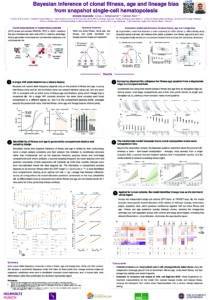
Clonal hematopoiesis (CH) arises when hematopoietic stem and progenitor cells acquire somatic mutations that expand during aging. Although CH has been extensively studied through bulk-sequencing variant allele fractions (VAFs), including longitudinal VAF trajectories, the latent determinants of clonal behaviour, fitness, clonal age, and lineage bias, remain difficult to resolve from cross-sectional data.
We present a Bayesian multi-compartment model that infers these quantities from snapshot single-cell data by coupling a hierarchical model of hematopoietic differentiation to binomial and multinomial observation models for clone-resolved cell counts across stem and progenitor compartments. Our model explicitly represents compartment-specific residence times and branch allocation probabilities, enabling joint inference of selective advantage, clone age, and clone-specific deviations from a wild-type differentiation program.
We evaluated our framework using simulations with known ground truth across multiple differentiation hierarchies. Snapshot single-cell data carried strong information on lineage bias and supported precise inference of fitness and clonal age with informative priors, slow downstream compartments, and more cells. Applied to two independent human single-cell hematopoietic datasets with clonal labels, the model recovered clone-specific branch allocation shifts consistent with lineage skewing and yielded plausible posteriors for fitness and age. Relative to naive clone frequencies, inferred branch effects removed many shifts, consistent with sampling and compositional noise in the raw data. Across cohorts, the dominant signal was altered differentiation propensity rather than differences in proliferative advantage.
Our framework provides a basis for disentangling selection and fate bias in CH from cross-sectional data and defines the kinetic regimes in which snapshot-based inference is informative.
Co-authors: Linus Schumacher, Carsten Marr
Contact Attendee
Warning: Attempt to read property "user_email" on string in /home/1276969.cloudwaysapps.com/ydbgzhdjeq/public_html/wp-content/plugins/my-conference-now/functions.php on line 2826