

B-S.B.31: MetaDiffusion: A process-aware conditional diffusion model for multi-species spatial range reconstruction from sparse observations
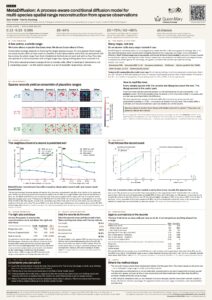
For most species we know only a few places where they have been seen, not where they live. Conservation assessment, including the range measures behind the IUCN Red List, must nonetheless infer whole ranges from those few records. Standard species distribution models treat each species alone and return a single map with no measure of uncertainty, which is unreliable when only five or ten
records exist.
We present MetaDiffusion, a conditional denoising-diffusion model that reconstructs the range of every species in a community from sparse presence records. Instead of one answer it returns an ensemble of plausible range maps. It is trained on Lotka--Volterra metacommunity simulations, in which every species' true range is known exactly, so reconstructions are scored against that
truth rather than against records held aside for testing. We test it on thirty simulated communities generated at parameter settings absent from training, revealing either a fixed budget of records per species or records drawn in proportion to a species' prevalence, which leaves most rare species with one or two.
Reconstructed ranges carry the geometry of the simulated truth: pooled across communities, the predicted and true distributions of range size, fragmentation and spatial spread agree closely (Kolmogorov--Smirnov distances $0.13$, $0.23$ and $0.095$). Recovery is local. Cells within two grid steps of a record are recovered several times above chance, while cells beyond that are recovered only at chance; a tuned Gaussian kernel smoother given the same records reaches the same floor, so the limit is not specific to our model. How often the ensemble brackets the true range shape rises with the number of records, from under a quarter at one record to about four fifths at five to nine, so an assessor can judge in advance how much a reconstruction is worth. A leave-one-out ablation
finds the occurrence records to be the only conditioning input carrying measurable signal at prediction time: ecological structure enters through the prior learned from the simulations, not through inputs supplied when a prediction is made. Against the smoother the division of labour is clear. The smoother finds twice as many individual cells, and confusion-matrix summaries that penalise false positives agree. Only MetaDiffusion reproduces range shape, and the union of its eight reconstructions matches the smoother's hit rate while the individual maps stay distinct, so the spread between them carries the uncertainty a single map hides.
https://doi.org/10.5281/zenodo.22175909
Contact Attendee
Warning: Attempt to read property "user_email" on string in /home/1276969.cloudwaysapps.com/ydbgzhdjeq/public_html/wp-content/plugins/my-conference-now/functions.php on line 2826