

B-S.B.23: A latent generative model for RNA-informed gRNA assignment and uncertainty quantification in single-cell CRISPR screens
José McFaline-Figueroa
Columbia University
Keywords
Latent generative model; neural networks; single-cell CRISPR screens
[sponser-meet-now-chat][/sponser-meet-now-chat]
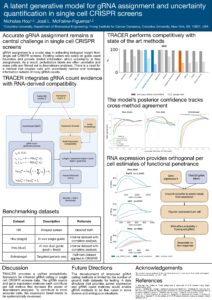
Accurate assignment of gRNA perturbations remains a central challenge in single-cell CRISPR screens, especially for ambiguous cells with noisy guide counts or potential multiplets. Existing callers rely on guide count heuristics and provide limited information about uncertainty in final assignments. We present a latent generative model that integrates guide count evidence with RNA-derived compatibility within a unified framework for perturbation calling. The model infers per-guide latent activity probabilities, models guide counts with an on/off negative binomial process, derives perturbation cardinality through a Poisson-binomial posterior, and decodes perturbation sets through a structural posterior over candidate assignments.
We benchmarked the model across three datasets: an internal pooled CRISPR screen, a public Perturb-seq dataset, and a public arrayed benchmark approximating ground truth. The model achieved competitive performance relative to 11 gRNA-calling methods, including 0.885 exact-match and 0.896 type-match accuracy on the internal dataset, 0.939 exact-match accuracy on the arrayed benchmark, and 94.95% agreement with a strong reference caller on the Perturb-seq dataset. The structural posterior yielded meaningful uncertainty estimates, with lower assignment entropy for correct than incorrect calls on both the internal and Perturb-seq datasets.
These results support joint modeling of RNA and gRNA counts as a practical route to more reliable perturbation calling. Future work will focus on disentangling transcriptional perturbation effects from correlated variability between guide counts and RNA profiles, and extending the model to capture guide-to-gene hierarchy.
Co-authors: José L. McFaline-Figueroa
Contact Attendee
Warning: Attempt to read property "user_email" on string in /home/1276969.cloudwaysapps.com/ydbgzhdjeq/public_html/wp-content/plugins/my-conference-now/functions.php on line 2826