

B-S.B.21: Interpretable AI for Risk Assessment (IARA): A Graph Neural Network Approach for Organ-Specific Hazard Prediction Using a Biomedical Knowledge Graph
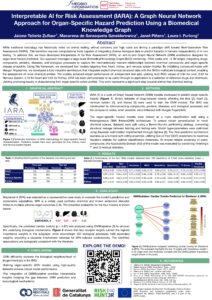
While traditional toxicology has historically relied on animal testing, ethical concerns and high costs are driving a paradigm shift toward Next-Generation Risk Assessment (NGRA). This transition requires computational tools capable of integrating diverse biological data to predict hazards in humans independently of in vivo testing. To address this, we have developed Interpretable AI for Risk Assessment (IARA), an end-to-end Graph Neural Network (GNN) architecture designed for organ-level hazard prediction. Our approach leverages a large-scale Biomedical Knowledge Graph (BKG) containing ~700k nodes and ~3.1M edges, integrating drugs, compounds, proteins, diseases, and biological processes to capture the mechanistically relevant relationships between chemical compounds and organ-specific disease endpoints. Using this framework, we developed four specialised models targeting liver, heart, kidney, and nervous system injuries. By initialising compound nodes with Morgan fingerprints, we developed a fully inductive architecture that integrates explicit chemical structural data with the BKG’s multiscale biological context, enabling the assessment of novel chemical entities. The models achieved robust performance on independent test sets, yielding AUC-ROC values of 0.84 for Liver, 0.82 for Nervous System, 0.79 for Heart and 0.64 for Kidney. IARA has been demonstrated to be useful through its application to a selection of reference drugs and chemicals, yielding promising results in characterising their organ-specific safety profiles. This work represents a significant step towards animal-free chemical testing.
Co-authors: Macarena de Sarasqueta Szneiderowicz, Janet Piñero, Laura Ines Furlong
Contact Attendee
Warning: Attempt to read property "user_email" on string in /home/1276969.cloudwaysapps.com/ydbgzhdjeq/public_html/wp-content/plugins/my-conference-now/functions.php on line 2826