

B-P.47: A Replicate-Based Molecular Dynamics Framework for Mapping Variant-Induced Structural and Network Perturbations in Drug-Metabolising NAT2 Enzyme
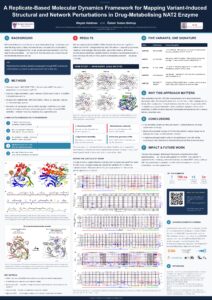
Investigating how residue variations alter enzyme structure and dynamic communication remains essential for understanding inter-individual variation in drug metabolism. We performed all-atom molecular dynamics simulations of human arylamine N-acetyltransferase 2 (NAT2), the enzyme responsible for metabolising the tuberculosis drug isoniazid, to determine how sequence variation drives the transition from rapid to slow acetylation phenotypes.
We developed a replicate-based comparative framework in which replicate-averaged rapid acetylator simulations define a reference state. Slow acetylator deviations were quantified relative to the reference mean and standard deviation across hydrogen bonding patterns, residue flexibility, and dynamic residue network centrality metrics which are then mapped to enzyme structure. This approach enables systematic identification of structurally and functionally meaningful perturbations rather than relying on single-trajectory comparisons.
Slow acetylator variants exhibited destabilisation of the active conformation characterised by altered hydrogen bonding, increased residue flexibility, and disrupted residue communication networks. In the R64Q+K268R variant for example, loss of hydrogen bonding at residue 64 propagated through the structural network, reducing betweenness centrality of catalytic residue D122 and putative isoniazid-binding residues S125 and F217. On the other hand, eigenvector centrality was reduced for N72, D122, and active-site loop G124, indicating reduced residue communication. In line with these changes, altered active-site geometry was observed via shortening of distances between binding residue F217 and catalytic residues H107 and D122.
Together, these results provide mechanistic insight into how distal residue variations propagate through dynamic residue networks to impair catalytic organisation, offering a transferable framework for studying structure/function relationships in pharmacogenetically relevant enzymes.
Co-authors: Ozlem Tastan Bishop
Contact Attendee
Warning: Attempt to read property "user_email" on string in /home/1276969.cloudwaysapps.com/ydbgzhdjeq/public_html/wp-content/plugins/my-conference-now/functions.php on line 2826