

B-P.32: Functional aggregation-prone regions mediate carbohydrate-binding and harbour disease-associated mutations
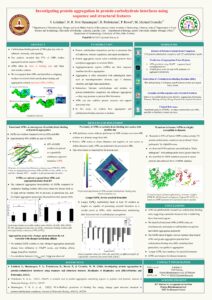
Carbohydrate-protein interactions play key roles in cellular processes such as cell-cell communication, differentiation, and immune response, and their disruption by mutations is implicated in several diseases. Emerging evidence suggests that aggregation-prone regions (APRs), which are associated with disease-related protein aggregation, occur near functional sites. However, the role of APRs in carbohydrate recognition is largely unexplored. We address this gap using a systematic sequence- and structure-based analysis of APRs in protein-carbohydrate interfaces using a curated dataset of 1119 carbohydrate-binding protein chains. We identified a distinct subset of residues in APRs that bind to carbohydrates, termed functional aggregation-prone regions (fAPRs). Our results show that ~40% of carbohydrate-binding residues overlap with APRs, indicating that aggregation propensity is tolerated within functional sites. The non-overlapping carbohydrate-binding residues are in spatial proximity to the APRs, contributing to intermolecular interactions. Notably, ~85% of fAPRs harbour at least one likely pathogenic missense mutation, highlighting their utility in the interpretation of variant pathogenicity. The fAPRs are enriched with aromatic residues, consistent with known carbohydrate-binding mechanisms. Despite the functional role, aggregation propensity and carbohydrate-binding affinity appear to be uncoupled, suggesting that aggregation and binding can be independently modulated. Overall, this study reveals fAPRs as important structural and functional elements at the protein-carbohydrate interface, offering new insights into carbohydrate-recognition and mutant effect prediction.
Co-authors: Siva Shanmugam N R, Prabakaran R, Rawat P, Michael Gromiha M
Contact Attendee
Warning: Attempt to read property "user_email" on string in /home/1276969.cloudwaysapps.com/ydbgzhdjeq/public_html/wp-content/plugins/my-conference-now/functions.php on line 2826