

B-G.C.10: Phylogenomic surveillance of outbreaks and antimicrobial resistance across German hospitals
Authors
Victoria Cepeda Espinoza
University Hospital Tübingen
Stephan Ossowski
University Hospital Tübingen
[sponser-meet-now-chat][/sponser-meet-now-chat]
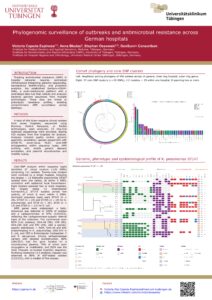
Background: Tracking antimicrobial resistance (AMR) in hospital networks requires centralized infrastructure integrating genomic sequencing, standardized bioinformatics, and predictive analytics. We established GenSurv+, a multi-institutional platform with a centralized data hub that collects and analyzes bacterial genome sequences from multiple technologies. These data are linked to phenotypic resistance profiles, enabling comprehensive AMR surveillance across Germany.
Methods: A total of 456 Gram-negative clinical isolates from seven hospitals, sequenced using Illumina, Oxford Nanopore, or PacBio technologies, were analyzed; 23 ring-trial duplicate sequencings were excluded, leaving 433 isolates from five hospitals for analysis. Analyses included quality control, genome assembly, annotation, species assignment with GTDB-Tk, seven-locus MLST, core-SNP phylogenetics within sequence types, AMR profiling with mobile genetic element annotation, and plasmid reconstruction and mobility typing.
Results: Core-SNP analysis within sequence types identified 37 clonal clusters (≤20 SNPs) comprising 111 isolates. Twenty-nine clusters were confined to a single hospital, including the largest — 12 Klebsiella pneumoniae ST307 isolates from one centre, all within 3 SNPs, consistent with sustained local transmission. Eight clusters spanned two or more hospitals, the largest being 13 Enterobacter hormaechei_C ST114 isolates across two centres, of which 6 were within 3 SNPs. Dominant sequence types were ST147 (n = 28), ST307 (n = 24) and ST395 (n = 19) for K. pneumoniae, and ST38 (n = 24), ST10 (n = 13) and ST69 (n = 12) for E. coli.
AMR genes were widespread: a beta-lactamase was detected in 100% of isolates and a carbapenemase in 97% (420/433), reflecting the carbapenemase-suspect referral basis of the collection. The commonest were NDM (141 isolates), OXA-48 (96), VIM (86), OXA-244 (64) and KPC (49), with a species-specific distribution — NDM, OXA-48 and KPC predominating in K. pneumoniae, OXA-244 in E. coli, and VIM in Enterobacter hormaechei_C and P. aeruginosa. Among carbapenemase carriers with plasmid reconstruction, 80% (284/357) had the gene located on a reconstructed plasmid, 70% of which were conjugative or mobilizable, and IS26 was the most frequent co-located insertion sequence. Multidrug resistance (≥3 antibiotic classes) was observed in 86% of AST-tested isolates (113/131), with a median of five classes.
Conclusion: GenSurv+ demonstrates that centralized integration of sequencing, plasmid analysis, and robust transmission detection supports effective AMR surveillance and intervention strategies.
Contact Attendee
Warning: Attempt to read property "user_email" on string in /home/1276969.cloudwaysapps.com/ydbgzhdjeq/public_html/wp-content/plugins/my-conference-now/functions.php on line 2826