

B-B.08: Tracking Respiratory Syncytial Virus Dynamics in Wastewater During the 2024-2025 Season in Switzerland
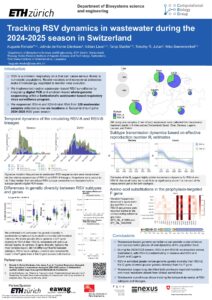
Respiratory Syncytial Virus (RSV) is responsible for considerable global health burden. The recent introduction of novel immunoprophylactic interventions highlights the need for population-level RSV genomic surveillance to monitor circulating lineages and detect mutations that may compromise intervention effectiveness.
In this study, we implemented wastewater-based RSV surveillance by integrating both pan- and subtype-specific digital PCR and amplicon-based sequencing within Switzerland's national wastewater monitoring program. We sequenced 328 wastewater samples, covering the RSV peak season from November 2024 to May 2025.
Viral loads from digital PCR showed co-circulation of RSV-A and B across all locations, with site-specific differences in subtype dominance. Subtype-specific effective reproduction numbers estimated from wastewater viral loads via Bayesian generative model implemented in EpiSewer indicated similar epidemiological trajectories for both subtypes.
Genomic sequencing data were processed using the viral NGS computational analysis software V-pipe. Lineage abundances in wastewater samples were reconstructed based on signature mutation frequencies using Lollipop, a deconvolution tool leveraging time-series information via a kernel smoothing approach. We found that for RSV-A, the A.D.1 and A.D.3 lineages predominated, while B.D.E.1 was dominant RSV-B lineage. We quantified genetic diversity using mutation richness and nucleotide diversity metrics and assessed differences across subtypes and genes using generalized linear mixed effects models. RSV-A exhibited higher genetic diversity than RSV-B, with greater diversity in G compared to the F gene, mirroring diversity patterns observed in clinical data.
Our findings demonstrate the potential of wastewater-based RSV surveillance for continuous tracking of viral dynamics in the context of widespread introduction of new immunoprophylaxis products.
Co-authors: Jolinda de Korne-Elenbaas, Adrian Lison, Tanja Stadler, Timothy R. Julian, Niko Beerenwinkel
Contact Attendee
Warning: Attempt to read property "user_email" on string in /home/1276969.cloudwaysapps.com/ydbgzhdjeq/public_html/wp-content/plugins/my-conference-now/functions.php on line 2826