

A-T.35: Analysis of Pipeline Robustness and Primer Binding Patterns in Split-Pool scRNA-seq
Author
Keywords
split-pool scRNA-seq, alignment pipeline, primer binding patterns
[sponser-meet-now-chat][/sponser-meet-now-chat]
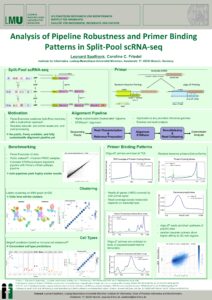
Single-cell RNA-sequencing (scRNA-seq) is a rapidly evolving technology that provides deep insights into gene expression and the regulation of cellular processes. Most commercially available sequencing kits rely on oligo-dT primers to reverse transcribe RNA molecules into cDNA for subsequent sequencing. These primers bind to poly-A sequences, which requires a poly-A tail in the target RNA. Additionally, the resulting reads are primarily located at the 3' end of the original RNA, which does not always capture sufficient transcriptomic information. Other approaches, such as the Parse Evercode chemistry, utilize random hexamer primers in addition to oligo-dT primers to enable binding across the entire RNA molecule. Parse also employs a split-pool approach during library preparation, which requires specialized read processing methods. While Parse provides a pipeline for the alignment and processing of this data, this Trailmaker pipeline is cloud-based and cannot be run on a local computing environment.
To address this, we developed a pipeline for processing of split-pool scRNA-seq data utilizing STARsolo. Our pipeline accounts for different primer types and automatically detects cellular barcodes from the reads. It is easily adaptable and its output is fully compatible with common scRNA-seq analysis frameworks like Scanpy and Seurat.
Using publicly available split-pool scRNA-seq data, we showed that our pipeline yields results highly concordant with Trailmaker at cellular, cell type, and gene levels. Furthermore, we investigated differences and biases between oligo-dT and random hexamer primers with regard to their binding patterns within a gene as well as between genes.
Co-authors: Caroline C. Friedel
Contact Attendee
Warning: Attempt to read property "user_email" on string in /home/1276969.cloudwaysapps.com/ydbgzhdjeq/public_html/wp-content/plugins/my-conference-now/functions.php on line 2826