

A-T.32: Gene regulatory network-based dynamic modeling of cellular differentiation trajectories
[sponser-meet-now-chat][/sponser-meet-now-chat]
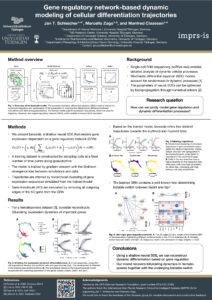
Dynamic differentiation processes determine the physiological and pathological behavior of all multicellular organisms. While single-cell RNA sequencing (scRNA-seq) enables the investigation of such processes, computational trajectory inference models are required to infer dynamics from snapshot gene expression measurements in the form of cell ordering and branching structure. However, such methods often neglect the underlying gene regulatory interactions. Differential equations can incorporate such interactions to model differentiation mechanistically and enable the simulation of gene expression dynamics. Since deterministic ordinary differential equation approaches cannot capture diverging differentiation from a shared initial state driven by the inherent stochasticity of gene expression, we present bowside, a stochastic differential equation (SDE) model based on gene regulatory networks (GRNs). Our model computes the rate of change of a gene's expression from the expression of its transcription factors using a weighted adjacency matrix. The GRN adjacency matrix structure is derived from a transcription factor database. Model parameters, including adjacency matrix weights, bias terms, and degradation rates, are optimized to minimize a distributional loss suitable for bifurcating differentiation that quantifies the difference between simulated sequences and cell distributions sampled from scRNA-seq data along (pseudo)time. We show that bowside infers the mutual inhibition of the fate-determining transcription factors GATA1 and SPI1 from a hematopoiesis scRNA-seq dataset and reconstructs diverging expression dynamics of the core GRN from a shared progenitor state to distinct cell fates. This work represents an important improvement over deterministic ordinary differential equation approaches to infer inherently stochastic differentiation dynamics from scRNA-seq data.
Co-authors: Marcello Zago, Manfred Claassen
Contact Attendee
Warning: Attempt to read property "user_email" on string in /home/1276969.cloudwaysapps.com/ydbgzhdjeq/public_html/wp-content/plugins/my-conference-now/functions.php on line 2826