

A-T.24: Multi-omics profiling of defined Ca2+ signals in mast cells
Keywords
multi-omics profiling; knowledge graphs; Ca2+ influx; mast cells
[sponser-meet-now-chat][/sponser-meet-now-chat]
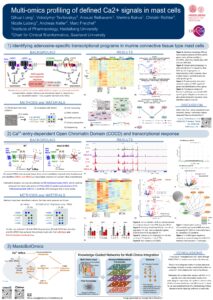
The combination of multi-omics data and network-based representations has been increasingly used to model complex biological relationships. We aim to apply this method to understand the signaling events upon Ca2+ influx in mast cells.
In mouse peritoneal mast cells (PMCs), we demonstrated that stimulation with agonists, including adenosine (ADO), compound 48/80 (C48/80), or antigen, triggers Ca²⺠influx via ORAI1 and ORAI2 channel proteins. We also found that influx Ca2+ governed by ORAI channels drives immediate release of preformed mediators (e.g., histamine) in PMCs. However, its role in newly synthesized inflammatory mediators and metabolic shifts remains unclear.
To unravel these Ca2+-entry-dependent mechanisms, we employed a multi-omic strategy comparing wild-type and Ca2+-entry-deficient (Orai1/2-double-knockout) PMCs under various stimuli. We integrate ATAC-Seq, bulk RNA-Seq, and miRNA-Seq to profile changes in chromatin accessibility and transcription, while utilizing proteomics, secretomics, and metabolomics to define the functional consequences of this reprogramming. These datasets are then analyzed using advanced computational frameworks and interpreted through knowledge-guided Graph Neural Networks to resolve the underlying regulatory circuits.
To date, we have defined an ADO-specific transcriptional program distinct from C48/80 and antigen responses in PMCs using bulk RNA-Seq (published). Using ADO and its analogues for stimulation, we identified over 500 Ca²âº-entry-dependent genes. By combining ATAC- and miRNA-Seq data, we constructed a Ca²âº-entry-dependent TF-miRNA-gene regulatory network.
This analysis will further integrate proteomics, secretomics, and metabolomics data to define the specific Ca2+-entry-dependent mechanisms, serving as the basis for an unprecedented level of understanding of these disease-relevant signaling pathways in mast cells.
Co-authors: Marc Freichel, Volodymyr Tsvilovskyy, Anouar Belkacemi, Merima Bukva, Christin Richter, Nicole Ludwig, Andreas Keller
Contact Attendee
Warning: Attempt to read property "user_email" on string in /home/1276969.cloudwaysapps.com/ydbgzhdjeq/public_html/wp-content/plugins/my-conference-now/functions.php on line 2826