

C-T.11: GOTFlow: Learning Directed Population Transitions from Cross-Sectional Biomedical Data with Optimal Transport
Authors
Predictive Systems in Biomedicine (PRISM) Lab, Department of Computer Science, University of Warwick
George Wright
Predictive Systems in Biomedicine (PRISM) Lab, Department of Computer Science, University of Warwick
Joanne Muter
Warwick Medical School, Division of Biomedical Sciences, University of Warwick
Jan Brosens
Warwick Medical School, Division of Biomedical Sciences, University of Warwick
Fayyaz Minhas
Predictive Systems in Biomedicine (PRISM) Lab, Department of Computer Science, University of Warwick
Keywords
Optimal Transport, Trajectory Inference, Population Flows, Gene Expression Dynamics
[sponser-meet-now-chat][/sponser-meet-now-chat]
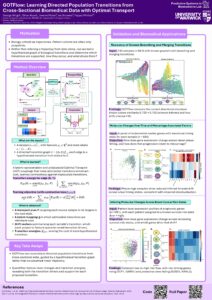
Motivation: Many biological and clinical processes are dynamic, yet most datasets are cross-sectional, capturing populations at discrete states rather than tracking individuals over time. This makes it difficult to quantify how populations change across developmental, physiological, or disease-associated conditions. Existing trajectory and transport-based methods often rely on fixed feature spaces, assumptions tailored to transcriptomic time-course data, or approximately linear progression, limiting their ability to model heterogeneous and unbalanced transitions across diverse biomedical modalities. Flexible methods are needed that can infer directed population-level change from cross-sectional data while retaining biological interpretability.
Results: We present GOTFlow, a framework for learning directed population transitions from cross-sectional biomedical data using graph-constrained optimal transport in a learned latent space. GOTFlow integrates representation learning with unbalanced optimal transport to jointly estimate embeddings and transport couplings between biological states. This enables hypothesis-driven modelling of progression structures while accommodating non-linear geometry, branching relationships, and changes in population mass. From the inferred transport plans, GOTFlow derives interpretable summaries of dynamics, including drift vectors quantifying transitions, and feature-level transported changes that highlight molecular drivers of progression. In synthetic data, GOTFlow recovered known transitions with strong agreement between inferred and ground-truth drifts. Across three biological applications, endometrial remodelling, breast cancer risk progression, and prion disease, GOTFlow identified state-to-state transitions and biologically meaningful feature shifts reflecting impaired decidualisation, increasing cancer risk, and neurodegenerative progression. These results establish GOTFlow as a general and interpretable framework for analysing directed population dynamics from cross-sectional data.
Availability: Code available at: https://github.com/wgrgwrght/GOTFlow.
Contact Attendee
Warning: Attempt to read property "user_email" on string in /home/1276969.cloudwaysapps.com/ydbgzhdjeq/public_html/wp-content/plugins/my-conference-now/functions.php on line 2826