

B-S.B.53: NELLY: A transparent deep learning framework for patient-centric drug response prediction and prioritization
Author
Keywords
drug_response_prediction, interpretable_deep-learning
[sponser-meet-now-chat][/sponser-meet-now-chat]
Introduction
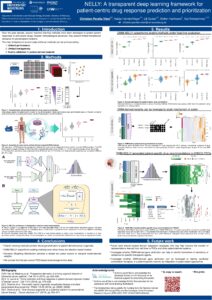
Over the past decade, several machine learning methods have been developed to predict patient responses to anti-cancer drugs. Despite methodological advances, they present limited translational relevance for personalized medicine. The main limitations of current state-of-the-art methods can be summarized by their inflated performance, limited transparency and scarce validation in patient-derived material.
Methods
Cancer drug response prediction models use gene expression and chemical information to learn patterns associated with treatment sensitivity. For training, we used gene expression data from Cell Model Passport and pharmacogenomic data from Genomics of Drug Sensitivity in Cancer.
To improve transparency, we developed NELLY, a deep learning model incorporating a dynamic weighting mechanism (DWM). This module enables extraction of patient-specific gene-level attributions associated with predicted patient response.
Models were trained and evaluated using a cell-line-blind 10-fold cross-validation to assess performance in unseen cell lines. Additionally, we applied recommendation-based methods, including Precision@K and NDCG@K to assess models' ability to rank the most effective drug for a given patient.
For independent validation with patient material, we have assembled a patient-derived-cancer-organoid pharmacogenomic atlas. The use of this fully independent dataset allowed us to evaluate generalization performance to clinically relevant samples.
Conclusion
We demonstrated that NELLY outperforms state-of-the-art models in generalization to cancer organoid data, achieving the best performance for patient-specific drug prioritization. Additionally, DWM-derived gene attribution analysis uncovered resistance-associated programs related to cancer cell plasticity, thereby adding mechanistic interpretability beyond drug ranking.
Co-authors: Nadja Harnischfeger, Lili Szabo, Stefan Hartmann, Kai Kretzschmar
Contact Attendee
Warning: Attempt to read property "user_email" on string in /home/1276969.cloudwaysapps.com/ydbgzhdjeq/public_html/wp-content/plugins/my-conference-now/functions.php on line 2826