

A-S.B.54: An interpretable deep-learning framework (BRS) identifies synergistic root-exudate metabolite combinations associated with nitrification inhibition in wheat
Author
Keywords
Deep-learning framework; root-exudate metabolites; Biological nitrification inhibition (BNI); Metabolite combinations
[sponser-meet-now-chat][/sponser-meet-now-chat]
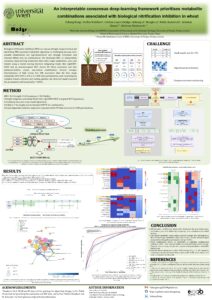
Biological nitrification inhibition (BNI) is a promising trait for improving nitrogen-use efficiency in wheat, yet its chemical determinants remain difficult to resolve from untargeted root-exudate metabolomics because of the high dimensionality of the data and nonlinear feature interactions. We analysed root-exudate metabolomes from 44 wheat accessions and formulated a supervised binary-classification task to predict the high-BNI phenotype. We developed an interpretable deep-learning framework, the Balanced Relevance Score (BRS), which uses an attention-augmented multilayer perceptron to learn feature relevance while integrating complementary evidence from SHAP attributions generated by LightGBM and stability selection using Elastic Net to improve robustness. The BRS framework prioritises not only individual metabolites but also synergistic combinations of metabolites, including pairs and triplets, associated with BNI activity. In our analysis, metabolite combinations showed more consistent discriminatory performance than individual metabolites, with the top-ranked single metabolites, pairs, and triplets achieving AUC values of up to 0.82. Permutation testing further showed that the predictive performance of the highest-ranked combinations exceeded that expected under label randomisation. The proposed framework provided new and systematic insights into key metabolites associated with BNI and their potential combinatorial effects. These findings suggest that several metabolites and their combinations may contribute to BNI regulation, thereby providing a conceptual basis and prioritised candidate targets for downstream functional validation and data-driven wheat breeding.
Co-authors: Wolfram Weckwerth, Palak Chaturvedi, Steffen Waldherr, Cristina Lopez-Hidalgo, Jiahang Li, Mengke Li, Arindam Ghatak
Contact Attendee
Warning: Attempt to read property "user_email" on string in /home/1276969.cloudwaysapps.com/ydbgzhdjeq/public_html/wp-content/plugins/my-conference-now/functions.php on line 2826