

A-S.B.29: SegTraQ: a Python package for segmentation quality control in spatial transcriptomics data
Authors
Daria Lazic
EMBL
Martin Emons
University of Zurich
Jieran Sun
Lausanne University Hospital
Wolfgang Huber
EMBL
Keywords
spatial, transcriptomics, segmentation, transcript, assignment, quality, control, assessment
[sponser-meet-now-chat][/sponser-meet-now-chat]
Early segmentation strategies for spatial transcriptomics relied on morphological stains that delineate cell boundaries within a single focal plane. This approach ignores several technical challenges in spatial transcriptomics data:
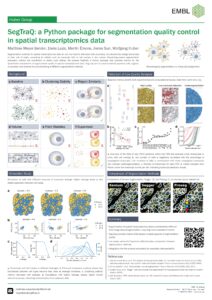
We introduce SegTraQ, a Python-based framework for segmentation and transcript assignment quality control in spatial transcriptomics data. SegTraQ computes quantitative metrics designed to highlight regions or samples with poorly segmented cells, and guide the choice of appropriate segmentation methods. Next to basic descriptors such as the number of genes, transcripts or cell morphology, we also provide metrics to evaluate how effectively the segmentation captures underlying biological structure. Spatially aware metrics quantify expression similarities between intracellular compartments and the local cellular neighborhood, and also assess the spatial distribution of transcripts within cells. For supervised QC, SegTraQ supports label transfer from scRNA-seq references and computes expression purity and signal spillover scores. Finally, we examine the ability of the segmentation to resolve transcripts belonging to overlapping cells across the z-dimension.
- Cells may be sectioned without their nuclei, leading to undersegmentation.
- Overlapping cells in the z-plane can appear as one cell in 2D projections, leading to mixed expression profiles.
- Transcript diffusion can occur during tissue processing, contaminating neighboring cells.
We introduce SegTraQ, a Python-based framework for segmentation and transcript assignment quality control in spatial transcriptomics data. SegTraQ computes quantitative metrics designed to highlight regions or samples with poorly segmented cells, and guide the choice of appropriate segmentation methods. Next to basic descriptors such as the number of genes, transcripts or cell morphology, we also provide metrics to evaluate how effectively the segmentation captures underlying biological structure. Spatially aware metrics quantify expression similarities between intracellular compartments and the local cellular neighborhood, and also assess the spatial distribution of transcripts within cells. For supervised QC, SegTraQ supports label transfer from scRNA-seq references and computes expression purity and signal spillover scores. Finally, we examine the ability of the segmentation to resolve transcripts belonging to overlapping cells across the z-dimension.
Contact Attendee
Warning: Attempt to read property "user_email" on string in /home/1276969.cloudwaysapps.com/ydbgzhdjeq/public_html/wp-content/plugins/my-conference-now/functions.php on line 2826