

A-P.46: Machine learning approaches for charting the functional and structural landscape of protein ubiquitination
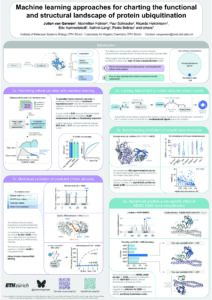
Protein ubiquitination regulates cell biology through diverse avenues, from quality control-linked protein degradation to regulatory functions such as modulating protein-protein interactions and protein conformations. Mass spectrometry-based proteomics has allowed proteome-scale quantification of hundreds of thousands of ubiquitination sites (ubi-sites), however the functional importance and molecular mechanisms of most ubi-sites remain undefined. By integrating multi-species proteomics data we found that regulatory ubi-sites may be more important than degradation-linked sites due to higher evolutionary conservation. To further prioritize regulatory ubi-sites performing cell-critical functions, we developed a machine learning-based ubi-site functional score by integrating evolutionary, proteomics, and structural features. Analysis of clinical genomics data and experiments with chemical genetics and genetic code expansion confirmed that our score pinpoints ubi-sites important for cellular fitness. Next, to pave the way for mechanistic interpretation of regulatory ubi-sites we developed an approach for modeling protein-protein covalent bonds - such as ubiquitination - in the deep-learning structural predictor AlphaFold3, which is not natively possible. We benchmarked this approach by re-predicting 338 experimental structures of ubiquitinated proteins in the Protein Data Bank, and achieved moderate-to-high accuracy across a range of protein types, including mono-ubiquitinated proteins, polyubiquitin chains, and catalytic intermediates of ubiquitin-processing enzymes. Combined with our ubi-site functional score, AlphaFold3 confirmed the regulatory potential of diverse ubi-sites by revealing ubiquitination-induced structural changes connected to protein functional states. Overall, we have leveraged machine learning through multiple avenues to chart the functional significance and structural consequences of ubiquitination at proteome-scale.
Co-authors: Pedro Beltrao
Contact Attendee
Warning: Attempt to read property "user_email" on string in /home/1276969.cloudwaysapps.com/ydbgzhdjeq/public_html/wp-content/plugins/my-conference-now/functions.php on line 2826