

A-P.44: Characterization of a highly diverged Cas7 homolog in Felix phages
Author
Keywords
VIPR, CRISPR-Cas, CRYO-EM, RNA-guided system, Phage-encoded defense system, Structural bioinformatics
[sponser-meet-now-chat][/sponser-meet-now-chat]
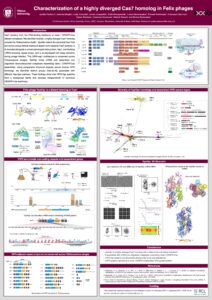
Cas7 proteins are essential structural components of Class 1 CRISPR-Cas effector complexes. They form a backbone that binds CRISPR RNA (crRNA) through an RNA Recognition Motif (RRM) fold to facilitate target recognition and interference. Apart from their role in the CRISPR-Cas system, no independent functions have been described. We identified Gp87, a highly diverged Cas7 homolog encoded by Felix phage VpaE1 outside any recognized CRISPR-Cas genomic context. Despite having minimal sequence conservation, structural models indicate that Gp87 shares the canonical Cas7 fold but lacks the typical active site and possesses two unique alpha-helical insertions. Using comparative genomics, biochemical experiments, structural modeling, and deep learning models we characterized Gp87 and its distribution across phages, archaea, and bacteria.
We found that Gp87 is co-expressed with Gp86, a helix-turn-helix (HTH) protein, and specifically binds to a flanking non-coding RNA (ncRNA) element containing GGTNN repeats. Structural models show that this interaction is mediated by Gp87's helical insertions which binds with the GG-rich repeats, an RNA-recognition process different from that of canonical Cas7 proteins. Furthermore, we identified that the architecture, comprising Gp87, Gp86, and the flanking ncRNA elements, is conserved not only across all known Felix phages, but also among diverse bacterial clades that maintain conserved GG-repeat regions and, in some groups, additionally encode flanking HNH endonucleases. This work reveals a novel, widespread Cas7-like system that operates independently of the CRISPR-Cas machinery, with a distinct RNA-binding mechanism and a transposon-associated genomic context.
Co-authors: Irmantas Mogila, Lidija Truncaitė, Lukas Valančauskas, Monika Šimoliūnienė, Kristupas Užkurnys, Tomas Šinkūnas, Česlovas Venclovas, Patrick Pausch, Darius Kazlauskas, Jonas Juozapaitis, Praneet Prabhanjan, Aistė Skorupskaitė
Contact Attendee
Warning: Attempt to read property "user_email" on string in /home/1276969.cloudwaysapps.com/ydbgzhdjeq/public_html/wp-content/plugins/my-conference-now/functions.php on line 2826