

A-P.25: FusionPath: Gene fusion pathogenicity prediction using protein structural data and contextual protein embeddings
Keywords
Variant interpretation, deep learning, protein language models, gene fusions, precision oncology
[sponser-meet-now-chat][/sponser-meet-now-chat]
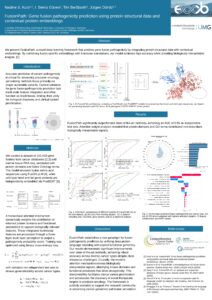
Accurate prediction of gene fusion pathogenicity is critical for understanding oncogenic mechanisms and advancing precision oncology. While existing computational methods provide valuable insights, their performance remains limited by incomplete integration of multi-scale biological features and insufficient model interpretability for clinical translation. We present FusionPath, a novel deep learning framework for gene fusion pathogenicity prediction that addresses these limitations through multimodal integration of complementary biological data. FusionPath uniquely integrates embeddings from multiple pretrained protein language models, including FusON-pLM and ProtBERT, alongside retained protein domains and Gene Ontology (GO) functional annotations. The model was trained and validated on a rigorously curated dataset of more than 70,000 gene fusions derived from FusionPDB, ChimerDB4.0, and 27 RNA-seq datasets of normal tissues. FusionPath significantly outperformed state-of-the-art methods and provides interpretable insights through SHAP analysis, revealing cancer-type-specific pathogenicity patterns and identifying protein kinase domains as key determinants of oncogenic potential. By synergistically leveraging sequence, structural, and functional information with explicit modeling of wild-type sequence context, FusionPath yields biologically grounded pathogenicity scores with mechanistic insights.
Co-authors: Irem Berna Güven, Tim Beissbarth, Jürgen Dönitz
Contact Attendee
Warning: Attempt to read property "user_email" on string in /home/1276969.cloudwaysapps.com/ydbgzhdjeq/public_html/wp-content/plugins/my-conference-now/functions.php on line 2826