

A-P.06: A pretrained model for RNA inverse folding with formal grammar representations
Author
Keywords
RNA inverse folding; conditional variational autoencoder; context-free grammar; RNA secondary structure; generative design
[sponser-meet-now-chat][/sponser-meet-now-chat]
Motivation: RNA inverse folding designs nucleotide sequences that fold into a given RNA secondary structure, enabling the creation and modification of functional RNAs. State-of-the-art solvers are largely search-based, but the search space grows exponentially with sequence length and structural complexity, and it is non-trivial to incorporate additional sequence-level constraints such as target GC content or family-specific conserved features.
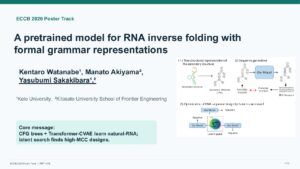
Results: We propose a generative model based on a Transformer-based conditional variational au-toencoder (CVAE) that takes a context-free grammar (CFG) parse-tree representation of the target secondary structure as input and generates sequences that fold into the specified secondary struc-ture. The grammar-based tree makes the hierarchical organization and base-pair correspondences explicit. By combining self-refinement learning and latent-space optimization, we substantially im-prove the recovery of high-fidelity solutions. On the EteRNA100 benchmark, our model alone achieves competitive accuracy, and the generated sequences consistently improve the success rate of downstream search-based solvers when used as warm starts. We further demonstrate controllable generation under GC-content constraints and improved family consistency through large-scale pre-training on natural RNAs.
Co-authors: Kentaro Watanabe, Manato Akiyama
Contact Attendee
Warning: Attempt to read property "user_email" on string in /home/1276969.cloudwaysapps.com/ydbgzhdjeq/public_html/wp-content/plugins/my-conference-now/functions.php on line 2826