

A-P.04: Protein language models for beta-lactamase detection and annotation
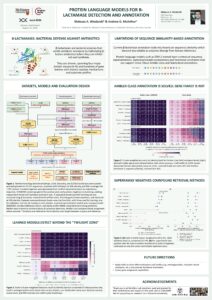
Accurate detection and functional annotation of β-lactamases is essential for antimicrobial resistance surveillance. Traditional sequence-search methods can identify many β-lactamases, but their performance may decline for highly divergent enzymes and when assigning finer-grained functional labels. We therefore compared eleven approaches for β-lactamase detection, Ambler class prediction, and family classification, including fine-tuned and frozen-embedding ESM-2 and ProstT5 models, nearest-neighbour label transfer, family-specific HMMs, MMseqs2 profiles, and DIAMOND. Models were evaluated on 52,331 β-lactamases grouped into 1,282 cluster-disjoint holdout units, using cluster-weighted recall at a matched 1% false-positive rate. Detection remained challenging for remote sequences. Below 20% similarity to any training reference, learned models retained 0.67–0.77 recall, whereas retrieval-based methods fell to 0.16–0.39; profile HMMs performed comparably to the fine-tuned language model within one confidence interval. The differences became even clearer when curated negatives were replaced with 93,341 proteins from β-lactamase-associated superfamilies. Learned models largely preserved their recall, while retrieval- and profile-based methods retained almost none, despite none of the models being trained on these sequences. Ambler class prediction was effectively solved by all approaches. Family assignment, however, remained difficult: recall ranged from only 0.08–0.21 against an achievable ceiling of 0.875, with alignment-based annotation performing best. Together, these results suggest that the main advantage of protein language models is their ability to recognize remote and superfamily-confounded β-lactamases, whereas reliable family-level annotation remains an open problem.
Co-authors: Andrew McArthurContact Attendee
Warning: Attempt to read property "user_email" on string in /home/1276969.cloudwaysapps.com/ydbgzhdjeq/public_html/wp-content/plugins/my-conference-now/functions.php on line 2826