

A-G.C.15: How Phosphorylation Affects Peptide Interaction with Adaptor Domains
Authors
Carter Wilson
Max Planck Institute for Multidisciplinary Sciences
Jonas Gellner
Max Planck Institute for Multidisciplinary Sciences
Volkhard Helms
Saarland University
Keywords
Alchemical Free Energy Calculations, Protein-Peptide Interactions
[sponser-meet-now-chat][/sponser-meet-now-chat]
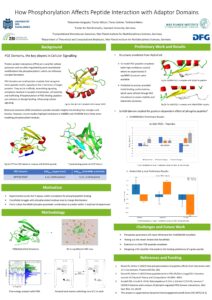
Protein-protein interactions (PPIs) are of fundamental relevance to numerous cellular processes and hence the focus of considerable experimental and computational efforts. They are often modulated by post-translational modifications such as phosphorylation, which can either favor or disfavor the formation of a particular complex. Molecular dynamics (MD) simulations offer a powerful framework for investigating the binding affinities, association kinetics, and structural pathways of protein complexes, including how mutations or phosphorylation events modulate these interactions. As a model system, we are studying PDZ domains in complex with phosphorylated vs. non-phosphorylated C-terminal peptides. Using available X-ray structures of Scribble and DLG PDZ domains, we computed relative binding free energy differences between phosphorylated and non-phosphorylated peptides. In the case of Scribble PDZ1, MD simulations with the CHARMM forcefield yielded free energy differences that closely matched experimental values, validating the applicability of this approach for studying phospho/non-phosphopeptide interactions. Can this be extended to systems lacking experimental support? We found that Alpha-Fold predicted PDZ-peptide systems that lacked NMR or X-ray data provided reliable starting points for MD simulations and free energy calculations. Together with improved water models (e.g., TIP4P) and adjusted phosphate group parameters, our results indicated stable interactions and binding free energies within the range of experimental observations. These results highlight the potential of combining structure prediction tools with MD simulations to study phosphorylation-dependent interactions.
Co-authors: Carter Wilson, Jonas Gellner, Volkhard Helms
Contact Attendee
Warning: Attempt to read property "user_email" on string in /home/1276969.cloudwaysapps.com/ydbgzhdjeq/public_html/wp-content/plugins/my-conference-now/functions.php on line 2826