

A-G.33: Impact of AI-assisted workflow standardization in a bioinformatics core facility
Author
Keywords
Bioinformatics core facilities · Large language models · Workflow standardization · Workflow engineering · Test-driven development · Reproducibility · Human oversight
[sponser-meet-now-chat][/sponser-meet-now-chat]
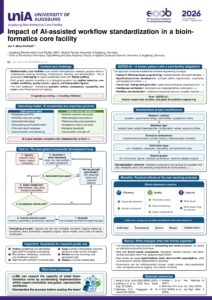
Bioinformatics core facilities often face a growing demand for reproducible, scalable, and rapidly deployable data analysis solutions across diverse project types. At the same time, many analyses are still implemented in an ad hoc manner, leading to inconsistencies in workflow structure, documentation, and long-term maintainability. Here, we describe the impact of AI-assisted workflow standardization in a university bioinformatics core facility, with a focus on the use of Nextflow as a unifying workflow framework and large language model (LLM)-based tools such as Claude Code and ChatGPT for rapid script and workflow generation.
We evaluated how AI-assisted development supported the design, refactoring, and documentation of standardized pipelines for common bioinformatics tasks, including data preprocessing, quality control, variant analysis, and downstream summarization. LLM-based tools were particularly useful for accelerating the generation of boilerplate workflow components, helper scripts, configuration templates, and documentation drafts, while human experts retained full responsibility for validation, benchmarking, and domain-specific adaptation. The combination of Nextflow-based standardization and AI-assisted implementation reduced development time, improved consistency across projects, and lowered the barrier for converting one-off analyses into reusable workflows.
Our experience suggests that AI-assisted workflow engineering can substantially improve operational efficiency in bioinformatics service environments when embedded in a controlled expert-driven framework. We argue that this approach is especially valuable for core facilities, where reproducibility, maintainability, and rapid turnaround are equally important.
Co-authors: None
Contact Attendee
Warning: Attempt to read property "user_email" on string in /home/1276969.cloudwaysapps.com/ydbgzhdjeq/public_html/wp-content/plugins/my-conference-now/functions.php on line 2826