

A-G.29: SVlog: Unlocking Structural Variation in Rare Diseases through an Extensible Logic Programming Framework
André Luiz Martins Reis
Garvan Institute of Medical Research
Meutia Kumaheri
Garvan Institute of Medical Research
Ira Deveson
Garvan Institute of Medical Research
Keywords
structural variation, genomics, logic programming, long-read sequencing
[sponser-meet-now-chat][/sponser-meet-now-chat]
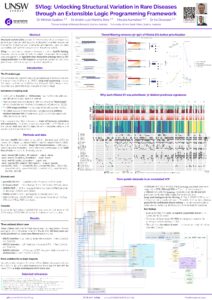
Structural variants (SVs) are a diverse group of genetic variants defined by a minimum size of 50 base pairs. SVs account for the majority of all variant bases in a person's genome, and have been frequently implicated in inherited disease and cancer. However, SV analysis is challenging due to imprecise breakpoints, variation in type and size, involvement of repetitive sequences, and general complexity of the induced changes to genomic elements. Despite recent advances in the detection and characterisation of SVs, it remains difficult to assess SVs beyond basic annotations and comparisons.
Here we introduce SVlog, a transparent and extensible meta-programming framework for analysing SVs. By utilising the logic programming language Soufflé, SVlog provides an algorithm-free, declarative ontology defining relationships among SVs and other elements. Genomic datasets are converted into relational facts, to which SVlog applies composable deterministic rules to assess SVs without relying on stochastic "black box" approaches.
Despite the compact codebase of the SVlog library, it currently evaluates more than 50 input predicates to generate over 60 informative output predicates, enabling SV annotation, comparison and prioritisation. Our tiered filtering strategy efficiently streamlines the identification of candidate pathogenic SVs in patients with rare inherited disease. Applied to our disease cohort, SVlog successfully prioritised all previously known pathogenic events, while also identifying novel candidates in several unsolved patients.
By focusing on explainability and modularity, SVlog offers a fast, reliable library for SV analysis and is a powerful deterministic alternative to traditional bioinformatics pipelines for clinical variant curation.
Co-authors: André Luiz Martins Reis, Meutia Kumaheri, Ira Deveson
Contact Attendee
Warning: Attempt to read property "user_email" on string in /home/1276969.cloudwaysapps.com/ydbgzhdjeq/public_html/wp-content/plugins/my-conference-now/functions.php on line 2826