

A-B.08: Designing effective dsRNAs for RNAi-based plant protection
Tamara Meckelburg
Martin Luther University Halle-Wittenberg
Juliane Schulz
Martin Luther University Halle-Wittenberg
Gregor Wittig
Martin Luther University Halle-Wittenberg
Torsten Gursinsky
Martin Luther University Halle-Wittenberg
Sven-Erik Behrens
Martin Luther University Halle-Wittenberg
Jan Grau
Martin Luther University Halle-Wittenberg
Keywords
RNA interference, RNAi, siRNA, CMV, RNAival
[sponser-meet-now-chat][/sponser-meet-now-chat]
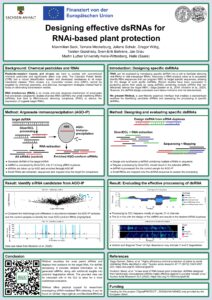
Pesticide-resistant insects and viruses are hard to combat with conventional chemical pesticides and significantly affect crop yield. The Colorado Potato Beetle (CPB) has a robust detoxification system and developed resistances to all major insecticide classes. Plant viruses, e.g. Cucumber Mosaic Virus (CMV), cannot be targeted by chemical pesticides, and management strategies must instead focus on eliminating transmission vectors.
RNA interference (RNAi) is an innate anti-viral response mechanism of eukaryotes that processes cytoplasmic double-stranded RNA (dsRNA) into small interfering RNAs (siRNAs) that bind to RNA-induced silencing complexes (RISC) to silence the expression of cognate target RNAs. This mechanism can be exploited by introducing dsRNA into a cell to facilitate silencing viral RNAs or vital messenger RNAs.
Advances in RNA analysis allow us to accurately identify RNA sequences that can program RISC to target specific sequences. Recent studies have been successful in protecting plants by using dsRNAs containing multiple siRNAs that can effectively silence the target RNA (Knoblich, 2025; Gago-Zachert, 2019).
The design and evaluation of these dsRNAs was labour-intensive and not standardised. We present a tool (RNAival, https://github.com/MaxiSack/RNAival) that provides a user-friendly graphical interface that enabled a standardised workflow for identifying siRNA candidates and assessing the dsRNAs processing. RNAival visualises the most potent siRNAs and interactively displays their positions on the target RNA. For dsRNA processing, it provides detailed information on the generated siRNAs, along with additional insights into potential degradation effects. Overall, RNAival offers practical support for researchers investigating siRNA-mediated RNA silencing.
Co-authors: Tamara Meckelburg, Juliane Schulz, Gregor Wittig, Torsten Gursinsky, Sven-Erik Behrens, Jan Grau
Contact Attendee
Warning: Attempt to read property "user_email" on string in /home/1276969.cloudwaysapps.com/ydbgzhdjeq/public_html/wp-content/plugins/my-conference-now/functions.php on line 2826